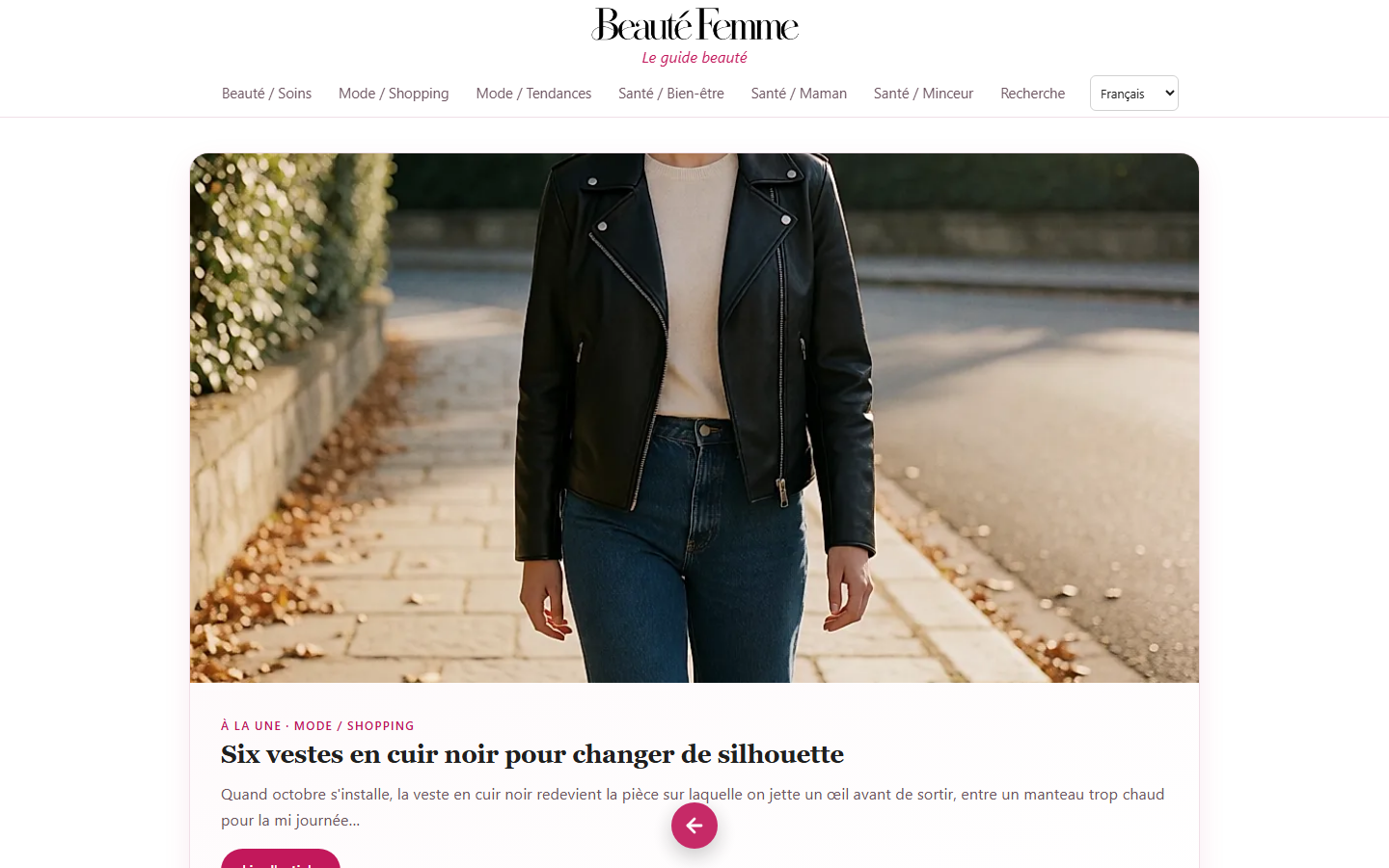
MUSE: an autonomous publishing engine — live demo: Beauté Femme
MUSE is an autonomous publishing engine — open source, multilingual, static and agent-driven: an AI newsroom (watch → writing → review → media → publishing) that produces, enriches and publishes content end to end. The engine is generic: everything sector-specific lives in a pack (editorial line, personas, agent prompts); an instance = one sector pack + one content set, kept out of the engine. The Beauté Femme portal runs on a full instance.
The project is open source and thoroughly tested: 566 automated tests, a static public front (vanilla HTML/CSS/JS, database-free — a database outage can never take the site down).
A three-layer architecture
- Core — the engine: static generator, agent orchestration, media chain, back-office, comments, CLI
- Sector pack — everything sector-specific: editorial line, sections, personas, agent prompts, policies
- Instance — the actual content (Markdown files + media), configuration and secrets, outside the engine
Two fully separate faces: the static public front (the browser only calls comments/ratings and tracked links) and the private back-office (token-protected, SSH tunnel) that orchestrates the agents, edits content and triggers rebuilds.
The newsroom: 23 agents
One agent proposes, another decides, a third writes, others review — and the last one can refuse.
- Watch — scout, trends, shopping watch, editorial arbitration
- Writing — persona-parameterised writing, legacy rewrites, shopping selections
- Review — corrector, fact-checker, quality controller, editorial director (APPROVE / REVISE / HOLD / REJECT)
- Media — art direction, illustrator, video, automatic audits
- Publishing — internal linking, translation, continuous publishing
Refusal is a verdict, not a failure: a non-compliant article is set aside, never polished forever — cycles are bounded. Every agent call is journaled (tokens, € cost) and shown live in the back-office Atelier: the whole campaign is auditable to the cent.
Multilingual by design
The pack declares its locales: the first is the language the newsroom writes in, the others are translation targets. One SEO slug per language (canonical, hreflang, translation family), automatic translation of missing or updated articles (a flow every 15 minutes), ratings shared across languages, comments per language.
Media: generated and audited
A full chain (ComfyUI: Krea-2 Turbo, Qwen-Image-Edit + Lightning LoRA, Wan 2.2 video) and a double automatic audit of every visual by a vision model: quality (anatomy, collages, no legible text, no logo) and relevance (the image must match its caption). For public figures, licensed photos (Wikimedia Commons), credited in the caption.
Monetisation & community
"Where to buy" links go through the internal /go/ redirector: every click is logged, then the reader is redirected. Multi-network affiliate switches without code, a deduplicated product catalogue, "shopping selection" articles built from themes. Moderated comments, ratings shared across languages, media likes — and a full back-office (cost Atelier, moderation, Design, page history).
The live demo
The Beauté Femme portal is a real instance of the engine — topics, selections and translations all come out of the pipeline:
→ Beauté Femme: beaute-femme.org
The public demo set examples/demo-content ships generic content (English test data) to bootstrap your own instance.